
Is It Hard to Get a Software Developer Job in 2026? Here's What the Data Shows
Is It Hard to Get a Software Developer Job in 2026? Here's What the Data Shows
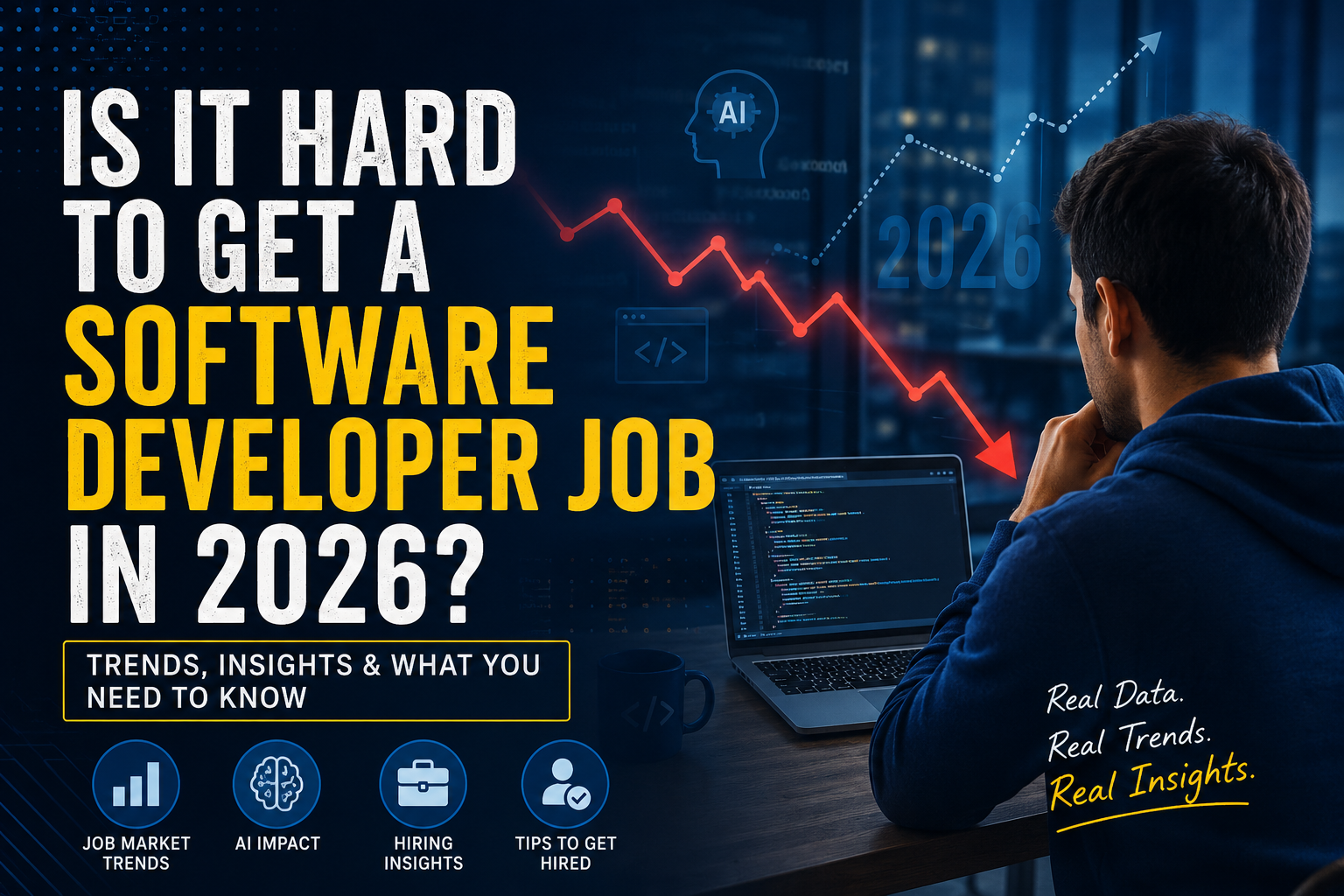
Introduction
Spend just ten minutes on LinkedIn, Reddit, or X, and you'll probably come across posts claiming that software development is no longer a safe career.
Some people blame Artificial Intelligence.
Others point to layoffs at major tech companies.
Then there are stories from fresh graduates who say they've applied to hundreds of jobs without receiving a single interview call.
When you see all of this together, it's easy to reach one conclusion:
"Software developer jobs are disappearing."
But is that actually true?
Not quite.
The software industry is definitely going through a period of change, but change doesn't always mean decline.
Hiring has slowed in some areas. Expectations have increased. AI has transformed the way developers work. At the same time, businesses continue investing in software, cloud platforms, cybersecurity, automation, and AI-powered products.
So the real question isn't whether software development is dying.
The better question is:
Why does getting a software developer job feel harder than it did a few years ago?
The answer has less to do with fewer jobs and much more to do with a changing market.
In this article, we'll look at what's happening behind the headlines, why many developers are struggling to find opportunities, which skills companies value today, and what aspiring engineers can do to stay competitive in 2026 and beyond.
Why So Many People Think Developer Jobs Are Declining
Every few years, the technology industry experiences a major shift.
Sometimes it's the rise of smartphones.
Sometimes it's cloud computing.
This time, it's Artificial Intelligence.
As AI coding assistants became more capable, social media quickly filled with dramatic predictions.
"Developers won't exist in five years."
"AI writes better code than humans."
"Learning programming is now a waste of time."
These statements spread quickly because fear attracts attention.
But headlines rarely tell the whole story.
The reality is more complicated.
Large technology companies did reduce hiring after the rapid recruitment boom that followed the pandemic. Many organizations paused expansion, restructured teams, or became more cautious about spending.
At the same time, startups faced tighter funding, which naturally reduced the number of open positions.
To someone searching for their first job, it looked as if opportunities had disappeared overnight.
In reality, the market wasn't disappearing.
It was correcting after an unusually aggressive hiring period.
The Hiring Boom Couldn't Last Forever
Between 2020 and 2022, demand for software developers reached extraordinary levels.
Businesses rushed to build digital products.
Remote work accelerated cloud adoption.
Online shopping expanded.
Streaming platforms grew rapidly.
Companies hired engineers faster than ever before.
Many organizations recruited more people than they actually needed because demand was growing so quickly.
Eventually, that pace became unsustainable.
As economic conditions changed, hiring naturally slowed.
Some companies reduced staff.
Others delayed recruitment.
This created the impression that software development had suddenly become a bad career choice.
But that's not what happened.
The industry simply moved from rapid expansion back toward a more balanced hiring environment.
AI Changed Expectations, Not the Need for Developers
Artificial Intelligence has undoubtedly transformed software development.
Tasks that once required hours of manual effort can now be completed much faster with tools like GitHub Copilot, ChatGPT, Cursor AI, and Claude.
Developers can generate code, write documentation, create test cases, and debug problems with AI assistance.
This has improved productivity across the industry.
However, productivity doesn't eliminate the need for skilled professionals.
Instead, it changes what employers expect.
Companies are now looking for developers who can evaluate AI-generated code, understand software architecture, solve business problems, and collaborate effectively with both people and intelligent tools.
In other words, AI isn't replacing developers.
It's raising the standard for what makes someone employable.
Why Fresh Graduates Feel the Pressure
If you're graduating in 2026, you might feel that the competition is tougher than ever.
That's because more people are learning to code than at any other time in history.
Universities continue producing computer science graduates.
Coding bootcamps remain popular.
Thousands of professionals from non-technical backgrounds are switching into software development.
The number of applicants has increased dramatically.
Employers now receive hundreds, sometimes thousands, of applications for a single entry-level position.
This doesn't mean companies aren't hiring.
It means standing out has become much more important.
A resume with only certificates is rarely enough anymore.
Recruiters want to see projects, internships, problem-solving ability, GitHub activity, and evidence that a candidate can contribute to real software development.
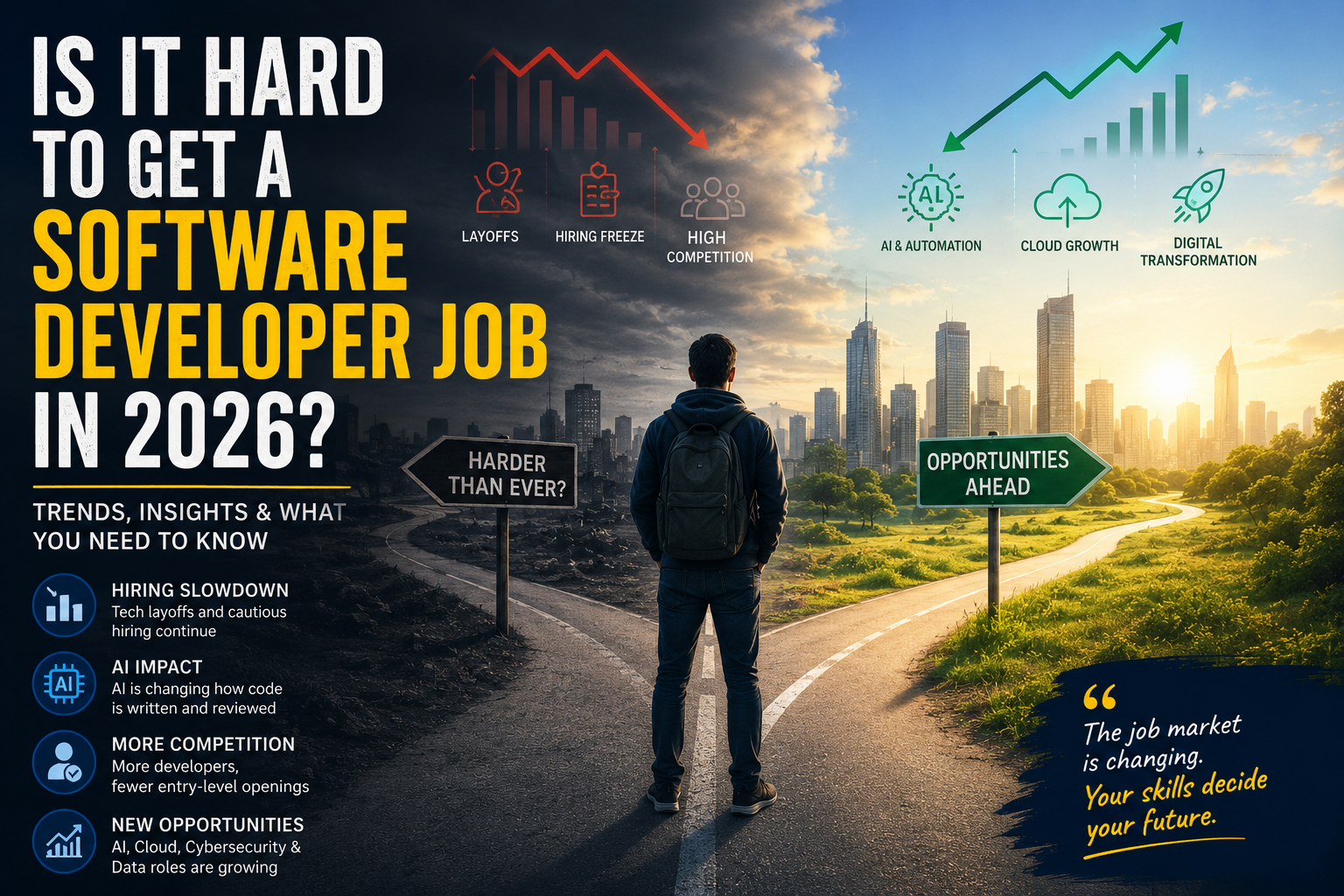
The Real Opportunity
Despite all the uncertainty, one fact remains unchanged.
Every modern business depends on software.
Banks.
Hospitals.
Schools.
Retail companies.
Manufacturers.
Government organizations.
Entertainment platforms.
Every industry continues investing in technology.
That means developers are still needed.
The difference is that employers are becoming more selective.
Instead of hiring anyone who knows basic programming, they're looking for candidates who can create value from day one.
For developers willing to keep learning, the opportunities haven't disappeared.
They've simply become more competitive.
Where Are the Opportunities in 2026?
If software developer jobs were truly disappearing, companies would have stopped investing in technology.
But that's not what's happening.
Look around and you'll notice that businesses are still building products faster than ever. Banks are launching digital services, hospitals are adopting AI-powered systems, retailers are improving online shopping experiences, and manufacturers are automating operations.
Software is still at the center of almost every industry.
What's changed is the type of developer companies are looking for.
Employers are becoming more selective because they have access to a larger talent pool. Instead of hiring someone who only knows syntax, they want engineers who can understand products, collaborate with teams, and solve real business problems.
The demand hasn't vanished.
The expectations have evolved.
Developer Roles That Continue to Grow
Not every software role has been affected in the same way.
Some specializations are expanding because businesses continue investing heavily in them.
AI and Machine Learning
Artificial Intelligence is creating new opportunities faster than it is replacing old ones.
Companies need developers who can integrate AI models into applications, automate workflows, and build intelligent products.
Knowing how to work with AI tools is quickly becoming an advantage during recruitment.
Cloud Computing
Very few modern applications run on local servers anymore.
From streaming platforms to banking apps, most software now depends on cloud infrastructure.
Cloud Engineers remain among the most sought-after professionals because every growing business needs secure, scalable, and reliable systems.
Cybersecurity
The more software we build, the more security challenges we create.
Organizations can't afford data breaches or system failures.
As cyber threats continue to evolve, developers with security knowledge are becoming increasingly valuable.
For many companies, protecting customer data isn't just a technical requirement. It's a business priority.
Full-Stack Development
Businesses appreciate developers who can contribute across multiple parts of a project.
A full-stack developer who understands frontend, backend, APIs, and databases often provides more flexibility than someone with expertise in only one area.
AI tools have actually strengthened this role by reducing repetitive coding work and allowing developers to focus on building complete products.
What Employers Want Today
A few years ago, listing several programming languages on a resume was often enough to attract attention.
That's no longer the case.
Recruiters now spend more time evaluating practical skills than memorized knowledge.
When hiring managers review candidates, they're usually asking questions like:
- Can this person solve unfamiliar problems?
- Have they built real projects?
- Can they explain technical decisions clearly?
- Do they understand teamwork?
- Can they learn new technologies quickly?
Notice that none of those questions mention a specific programming language.
That's because technical skills open the door.
Problem-solving and communication often determine who gets hired.
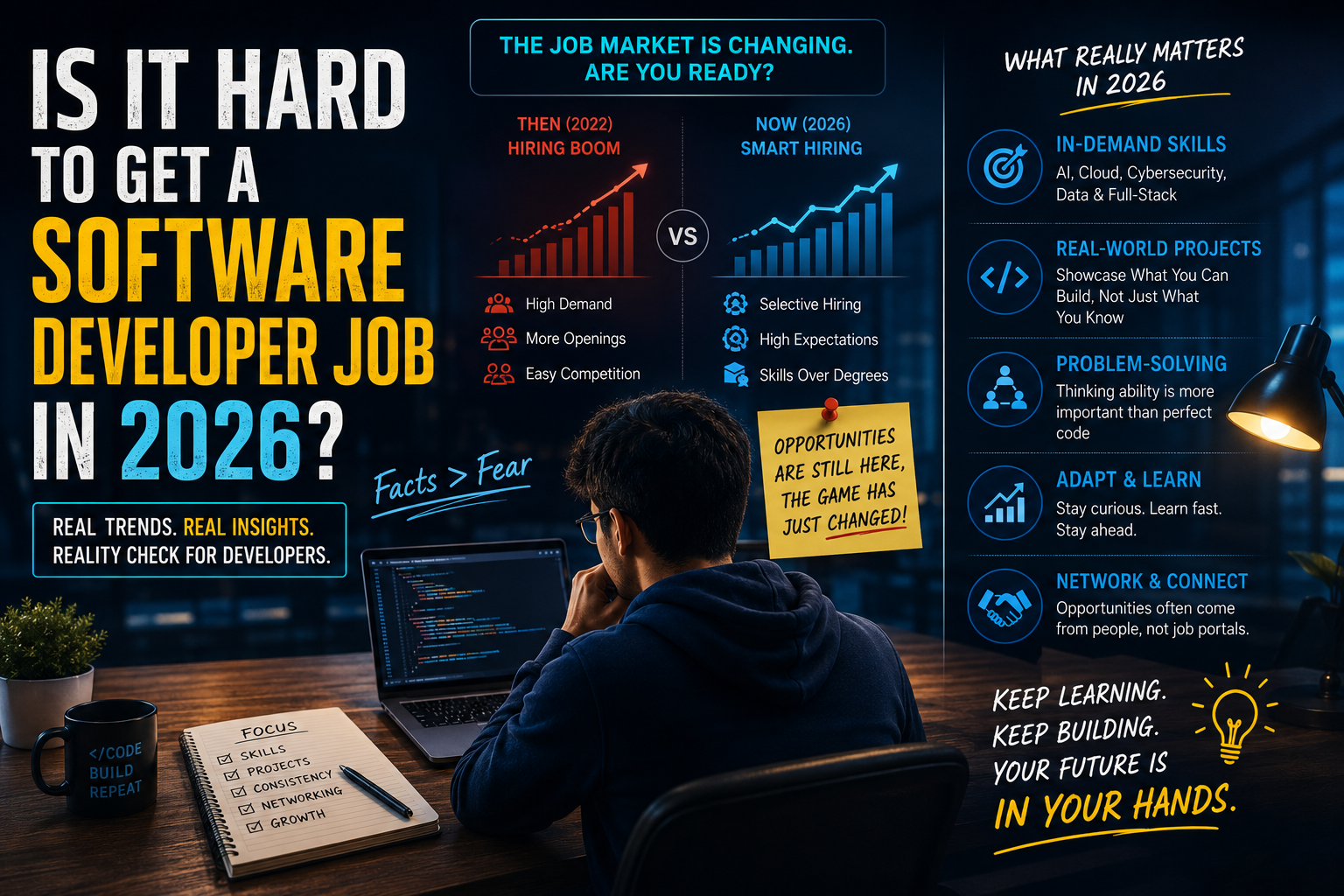
Why Some Candidates Get Interviews Faster
Two applicants may graduate from the same university with similar grades.
Yet one receives interview invitations while the other struggles.
The difference usually isn't luck.
It's preparation.
Candidates who build personal projects, contribute to GitHub, write technical blogs, participate in hackathons, or complete meaningful internships naturally stand out.
Recruiters don't just want potential.
They want proof.
Even a small but well-built application can demonstrate more practical ability than a long list of certificates.
Industries That Are Still Hiring Developers
One reason people believe software jobs are declining is because they focus only on large technology companies.
Big Tech attracts headlines.
But it represents only a small part of the overall job market.
Software developers are needed across almost every industry.
Healthcare organizations need digital health platforms.
Financial institutions invest heavily in secure applications.
E-commerce businesses continuously improve customer experiences.
Manufacturing companies rely on automation.
Educational platforms are expanding online learning.
Even traditional businesses now depend on software to remain competitive.
In many cases, opportunities exist outside the companies everyone talks about.
The Importance of Adaptability
Perhaps the biggest lesson from the current market is this:
Technology changes.
Successful developers change with it.
The engineers who learned cloud computing during its early growth gained a significant advantage.
The same thing is happening with AI today.
You don't need to become a machine learning expert overnight.
But understanding how modern AI tools fit into software development can make you a stronger candidate.
The goal isn't to compete against AI.
The goal is to become the developer who knows how to use it effectively.
How to Improve Your Chances of Getting Hired in 2026
The software job market is more competitive than it was a few years ago, but that doesn't mean it's impossible to break into the industry.
In fact, many companies are still hiring.
They're simply looking for stronger candidates.
If you're starting your career today, don't focus on applying to hundreds of jobs with the same resume.
Focus on becoming someone recruiters want to interview.
That starts with building practical skills.
Learn one programming language well instead of trying to learn five at once.
Create projects that solve real problems.
Understand Git, APIs, databases, and cloud fundamentals.
Most importantly, learn how to explain your work.
During interviews, employers aren't just evaluating your code.
They're trying to understand how you think.
The ability to communicate your decisions clearly often makes a bigger difference than people realize.
Common Mistakes That Make the Job Search Harder
Many talented candidates unknowingly make their own job search more difficult.
One of the biggest mistakes is relying only on online certificates.
Certificates show that you've completed a course.
Projects show that you've actually learned something.
Another common mistake is applying for every opening without reading the job description.
A backend developer shouldn't submit the exact same resume for a frontend role.
Small changes that match the employer's requirements can significantly improve your chances.
Some candidates also ignore networking.
Many opportunities come through referrals, LinkedIn connections, hackathons, developer communities, and open-source contributions.
Building relationships within the industry can sometimes be just as valuable as building technical skills.
Finally, don't underestimate consistency.
Submitting ten strong applications is usually more effective than sending one hundred generic ones.
The Role of AI in Your Career
There's a temptation to see AI as either the enemy or the solution to everything.
Neither perspective is accurate.
AI is simply another tool.
Just as developers use IDEs, GitHub, testing frameworks, and cloud platforms, they're now using AI assistants to improve productivity.
The developers who succeed won't be the ones who avoid AI.
They'll be the ones who understand its strengths and limitations.
Knowing when to trust AI, when to verify its output, and when to solve problems independently is becoming a valuable professional skill.
Think of AI as a teammate.
A very fast teammate.
But one that still needs supervision.
Frequently Asked Questions
Are software developer jobs declining?
Not exactly.
Hiring has slowed compared to the rapid growth seen during the pandemic, but software developers remain in demand across industries such as finance, healthcare, cybersecurity, AI, education, and cloud computing.
Is it harder to get a software developer job in 2026?
For many fresh graduates, yes.
Competition has increased, and employers expect stronger practical skills than before.
However, candidates with solid projects, internships, and problem-solving abilities continue to receive opportunities.
Will AI replace software developers?
AI is automating repetitive coding tasks, but it isn't replacing skilled software engineers.
Developers who know how to work with AI are becoming more valuable in today's job market.
Which software developer roles have the best future?
Cloud Engineering, AI Engineering, Machine Learning, Cybersecurity, DevOps, Data Engineering, and Full-Stack Development continue to show strong long-term demand.
What should students focus on?
Build a strong foundation in programming, create real-world projects, understand Git and cloud basics, practice problem-solving, and stay updated with AI tools instead of fearing them.
Final Thoughts
It's easy to become discouraged after reading headlines about layoffs, automation, or Artificial Intelligence.
But headlines rarely capture the complete picture.
The software industry isn't disappearing.
It's evolving.
Companies still need developers who can solve problems, build reliable systems, collaborate with teams, and understand how technology creates business value.
Those qualities have always mattered.
AI hasn't changed that.
If anything, it has made them even more important.
Instead of asking whether software development is still a good career, ask yourself a different question:
"Am I building the skills that employers will need over the next five years?"
That's the question that truly shapes a career.
Technology will continue changing.
Programming languages will evolve.
New tools will emerge.
But developers who stay curious, adapt quickly, and keep learning will continue to find opportunities, no matter how the industry changes.
Key Takeaways
- Software developer jobs are evolving, not disappearing.
- AI is changing hiring expectations rather than eliminating developer roles.
- Practical skills, projects, and communication matter more than ever.
- Cloud computing, AI, cybersecurity, and DevOps remain strong career paths.
- Continuous learning is the biggest advantage in a rapidly changing industry.
About the Author
Boost Your Career
Explore our most popular career resources.
Share Your Insight
Contribute thoughtfully to the discussion. Your perspective matters.
Join the Conversation
Sign in to share your thoughts and contribute to this discussion
Discussion
Thoughtful insights from the community
No comments yet
Be the first to share your thoughts