
Will AI Really Replace Software Developer Jobs in 2026? The Truth Revealed
🤖 AI Summary
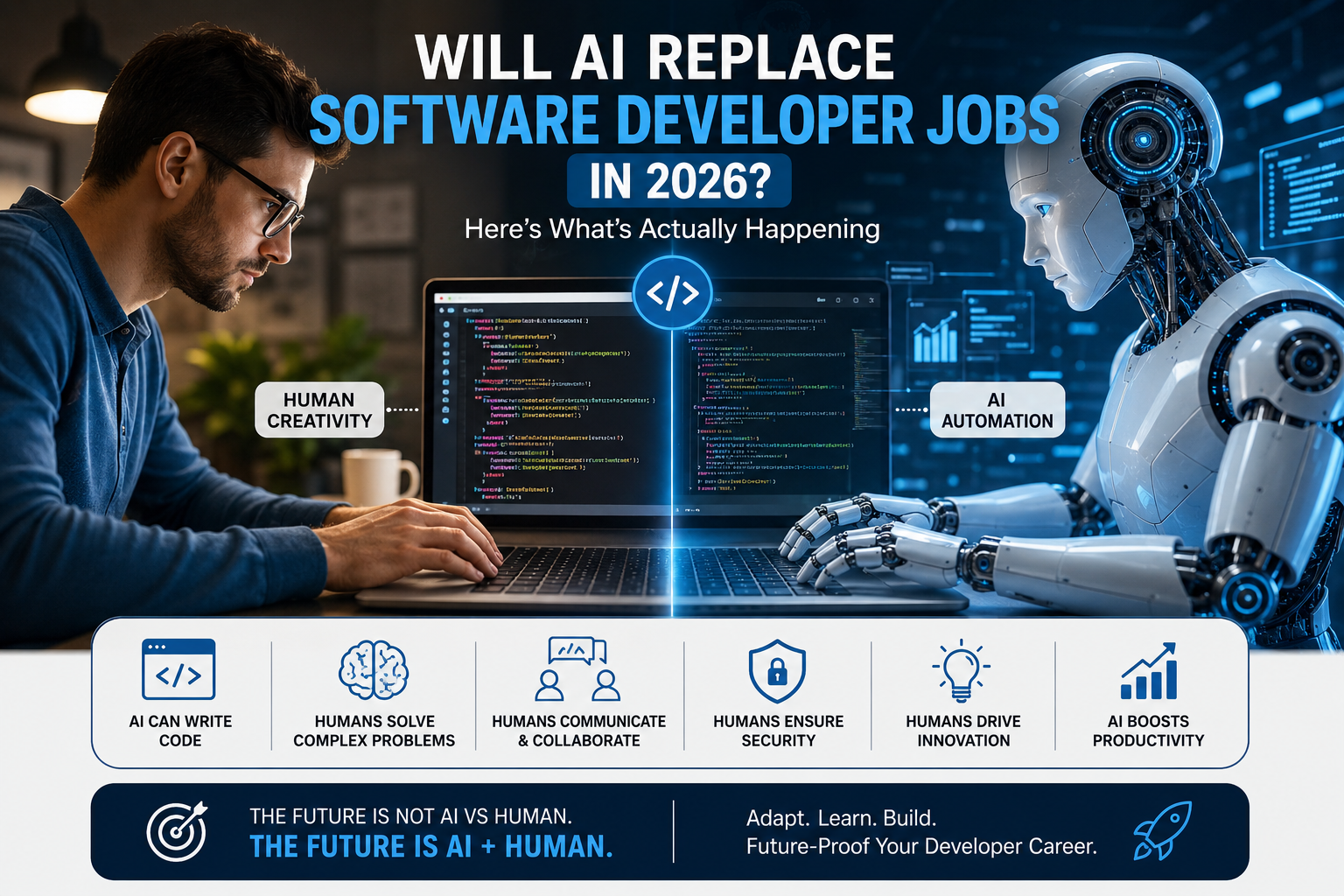
Will AI Really Replace Software Developer Jobs in 2026? Here's What's Actually Happening
Quick Answer (AI Overview Optimized)
No, AI is not expected to replace software developers entirely in 2026. Instead, AI is changing how developers work by automating repetitive coding tasks, improving productivity, and increasing the demand for professionals who can effectively use AI tools. Developers who adapt to AI are likely to have stronger career opportunities than those who ignore it.
Introduction
Artificial Intelligence has become one of the biggest talking points in the technology industry. Every week, a new AI tool promises to generate code, build websites, debug applications, or even replace entire development teams.
This has created a common question among students, fresh graduates, software engineers, and even parents:
"Will AI replace software developer jobs in 2026?"
The concern is understandable.
Tools like ChatGPT, GitHub Copilot, Cursor AI, Claude, and Gemini can now write code in seconds. Tasks that once required hours of manual work can often be completed with a well-written prompt.
At first glance, it may seem like software developers are becoming less important.
However, the reality is far more nuanced.
Companies are not simply looking for people who can type code. They are hiring professionals who understand business problems, design scalable systems, communicate with teams, review AI-generated code, ensure security, and build products that solve real customer needs.
In fact, many organizations are now looking for AI-assisted developers rather than developers who avoid AI altogether.
This shift is creating new opportunities while changing the skills employers expect.
What Does AI Mean in Software Development?
Artificial Intelligence in software development refers to tools and systems that assist developers throughout the software development lifecycle.
Modern AI can help with:
- Writing boilerplate code
- Generating functions
- Explaining complex code
- Finding bugs
- Refactoring applications
- Creating documentation
- Writing unit tests
- Suggesting performance improvements
- Translating code between programming languages
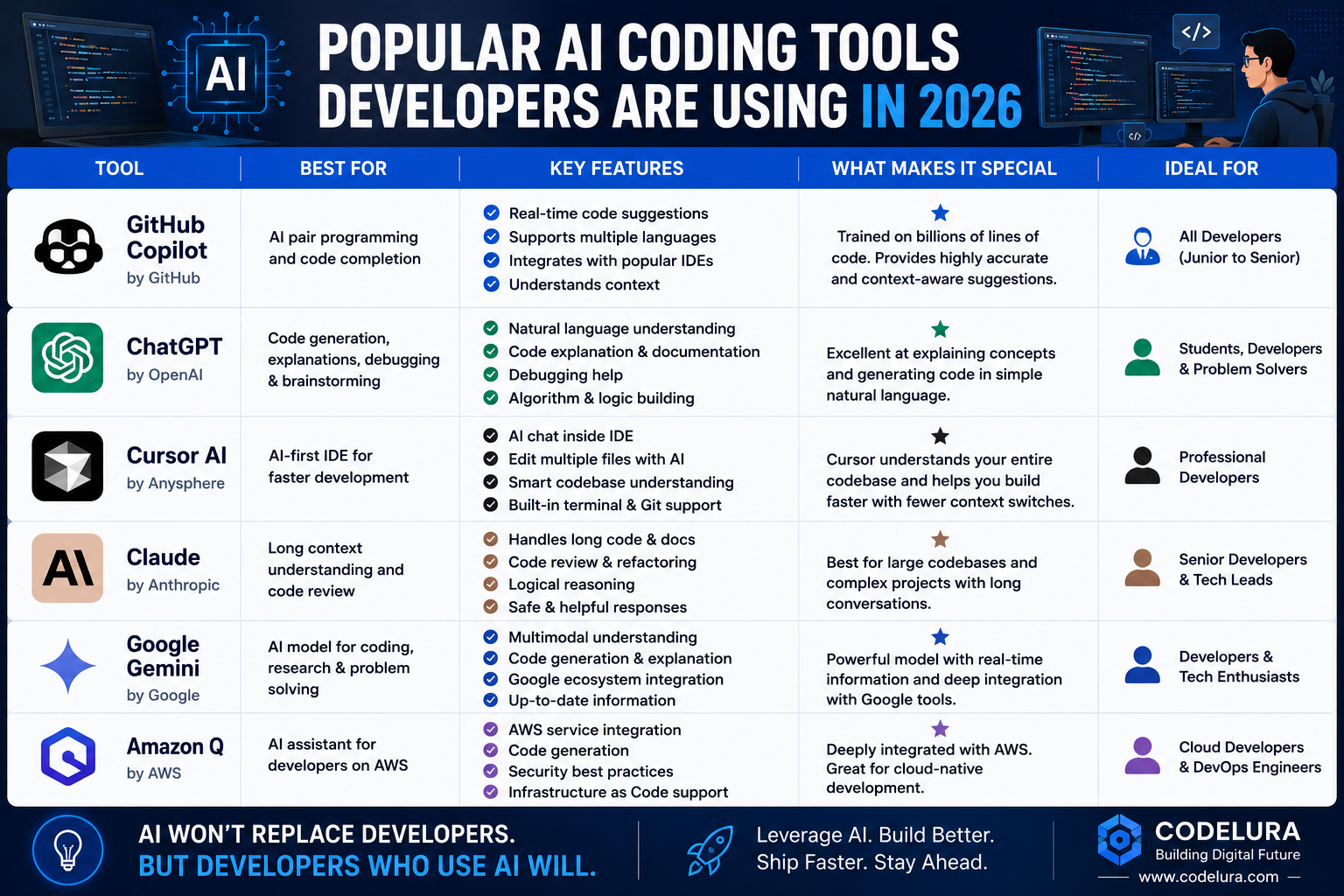
Popular AI coding tools include:
- ChatGPT
- GitHub Copilot
- Cursor AI
- Claude
- Gemini
- Amazon Q
- Codeium
These tools are designed to improve developer productivity, not automatically replace experienced engineers.
Think of AI as a highly capable coding assistant rather than a complete software engineer.
A calculator never replaced mathematicians. It simply allowed them to solve problems faster. AI is beginning to play a similar role for developers.
Why Is Everyone Saying AI Will Replace Developers?
There are several reasons behind the growing fear.
1. AI Writes Code Instantly
Watching AI generate hundreds of lines of code within seconds is impressive.
Many people assume that if AI can write code, developers are no longer needed.
However, writing code is only one part of software engineering.
Developers also:
- Understand client requirements
- Design software architecture
- Make technical decisions
- Review code quality
- Ensure application security
- Test edge cases
- Optimize performance
- Maintain systems over time
AI still struggles with many of these responsibilities without human oversight.
2. Companies Are Investing Heavily in AI
Major technology companies have integrated AI into their development workflows.
Organizations are encouraging employees to use AI tools to increase productivity and reduce repetitive work.
This has created headlines suggesting AI is replacing programmers.
In reality, most companies are using AI to help developers accomplish more in less time rather than eliminating engineering teams altogether.
3. Social Media Creates Panic
Platforms like LinkedIn, X, and YouTube often amplify extreme opinions.
Headlines such as:
- "Programming Is Dead"
- "AI Replaced My Job"
- "No One Will Hire Developers"
generate attention because fear attracts clicks.
The actual job market is much more balanced. While routine coding tasks are becoming automated, demand remains strong for developers who can solve complex problems, collaborate with teams, and effectively use AI tools.
Current Hiring Trends in 2025-2026
The software development job market is changing, but it is not disappearing.
Several trends are becoming increasingly clear:
AI Skills Are Becoming Essential
Employers are actively seeking developers who understand how to work with AI-powered tools to improve productivity.
Knowing how to write effective prompts, review AI-generated code, and integrate AI APIs into applications is becoming a valuable skill.
Full-Stack Developers Are in High Demand
Companies increasingly prefer developers who can work across multiple technologies instead of specializing in only one area.
Developers who understand frontend, backend, databases, cloud services, and AI integration are more competitive in today's market.
Problem Solving Matters More Than Syntax
Since AI can generate code quickly, employers are placing greater emphasis on:
- System design
- Analytical thinking
- Communication
- Product understanding
- Debugging
- Architecture
- Collaboration
These are skills AI cannot reliably replace.
AI Is Creating New Roles
Rather than reducing opportunities, AI is creating new positions such as:
- AI Application Developer
- AI Integration Engineer
- Prompt Engineer
- AI Automation Specialist
- Machine Learning Engineer
- AI Product Engineer
This indicates that the industry is evolving instead of shrinking.
What You'll Learn in This Guide
By the end of this article, you'll understand:
- Which software development tasks AI can already automate.
- Which responsibilities still require human expertise.
- Which developer jobs are most at risk.
- Which programming careers are expected to grow through 2030.
- The skills students and developers should focus on today.
- How to future-proof your software development career in the age of AI.
What AI Can Already Do in Software Development
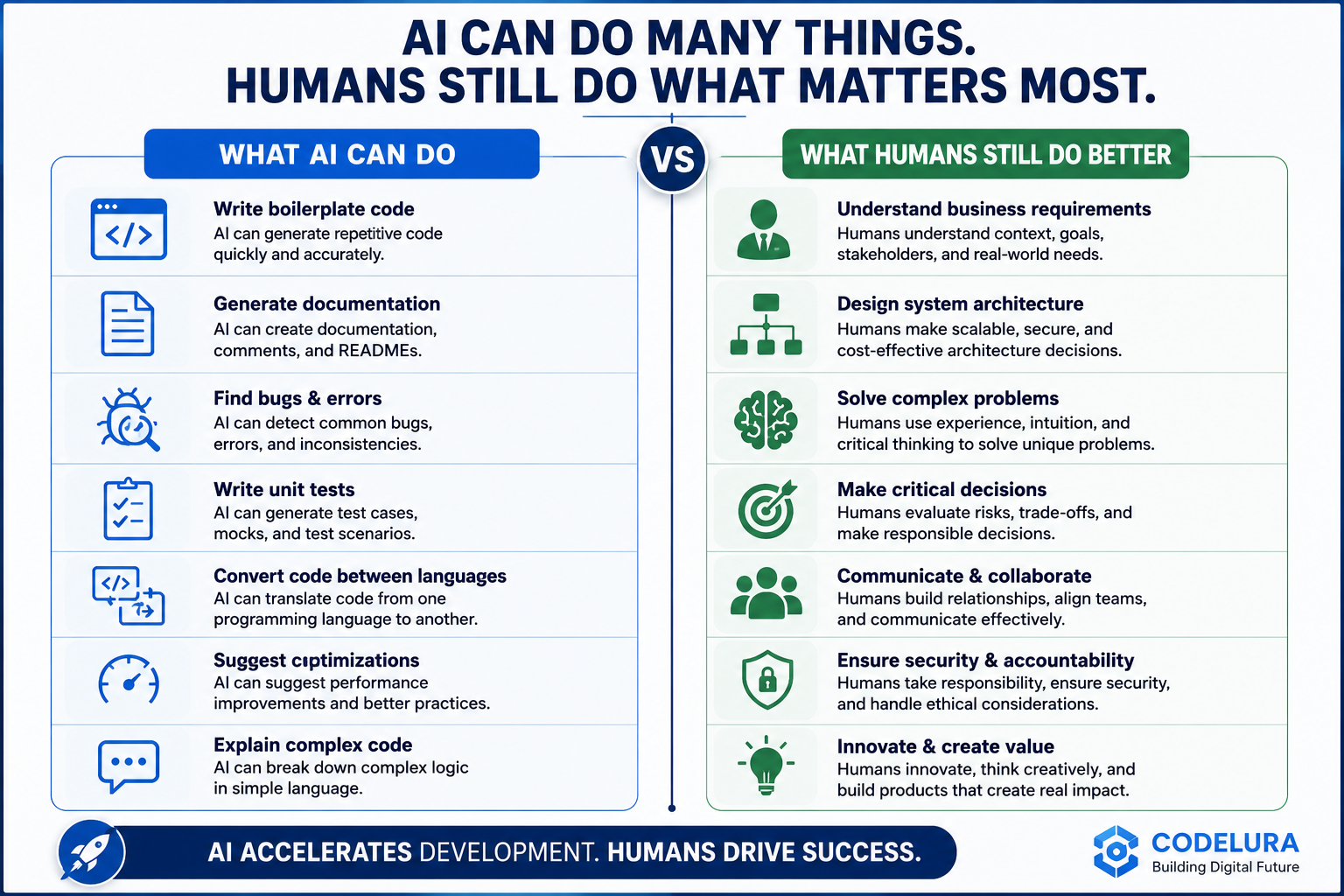
Artificial Intelligence has evolved from being a simple code suggestion tool to becoming an intelligent development assistant. Modern AI can significantly reduce the time developers spend on repetitive tasks, allowing them to focus on solving business problems and building better software.
However, understanding what AI can actually do is essential before assuming it can replace software developers.
1. Generate Boilerplate Code
One of AI's biggest strengths is generating repetitive code.
For example, instead of manually creating:
- CRUD APIs
- Login pages
- Database models
- Authentication systems
- Form validation
- REST endpoints
developers can simply describe their requirements in natural language.
Within seconds, AI produces a working starting point.
This saves hours of repetitive coding.
2. Explain Existing Code
Many developers work on projects written by someone else.
Understanding unfamiliar code often takes hours.
AI tools can instantly explain:
- Complex functions
- Regular expressions
- Algorithms
- SQL queries
- Framework-specific code
This makes onboarding faster for junior developers.
3. Debug Common Errors
Developers spend a large part of their day fixing bugs.
AI can identify:
- Syntax errors
- Missing imports
- Incorrect variable names
- Type mismatches
- Basic logical mistakes
It can also suggest possible fixes.
Instead of searching dozens of Stack Overflow posts, developers receive explanations immediately.
4. Write Documentation
Documentation is important but often ignored.
AI can generate:
- Function descriptions
- README files
- API documentation
- Installation guides
- Code comments
Developers can then review and improve the generated content.
5. Convert Code Between Languages
Modern AI can translate code across programming languages.
For example:
- Python → Java
- JavaScript → TypeScript
- C++ → Python
- Java → Kotlin
While manual review is still necessary, AI significantly speeds up migration projects.
6. Generate Unit Tests
Testing is one of the most repetitive parts of development.
AI can automatically generate:
- Unit tests
- Mock data
- Edge case suggestions
- Test scenarios
This helps improve software quality while reducing development time.
7. Improve Productivity
Perhaps AI's greatest contribution is increasing developer productivity.
Instead of replacing developers, AI allows them to complete more work in less time.
Developers using AI often spend less time writing repetitive code and more time designing better solutions.
What AI Still Cannot Replace
Despite rapid improvements, AI has significant limitations.
Software engineering involves much more than writing code.
1. Understanding Business Requirements
Imagine a client says:
"Build an app that helps hospitals reduce patient waiting time."
This isn't a coding problem.
It's a business problem.
Developers must ask questions such as:
- Who are the users?
- What are the biggest pain points?
- How should appointments work?
- What security measures are required?
- Which regulations apply?
AI cannot independently gather business requirements or negotiate with stakeholders.
2. Software Architecture
Writing code is relatively easy.
Designing large systems is much harder.
Experienced developers decide:
- Database architecture
- Microservices vs monolith
- API design
- Scalability
- Security
- Performance optimization
- Cloud infrastructure
Poor architectural decisions can cost companies millions.
AI can suggest ideas but cannot take full responsibility for these decisions.
3. Communication
Developers spend far more time communicating than many people realize.
Daily activities include:
- Client meetings
- Sprint planning
- Code reviews
- Team discussions
- Product brainstorming
- Requirement analysis
AI cannot replace the human collaboration needed in software projects.
4. Creativity and Innovation
Companies don't hire developers simply to write code.
They hire people to solve problems creatively.
Questions like:
- How can we improve user experience?
- Which feature should be built first?
- What makes this product different from competitors?
require human judgment, creativity, and business understanding.
5. Security Decisions
Security is one of the biggest weaknesses of blindly generated AI code.
AI may unintentionally suggest:
- Insecure authentication
- Vulnerable SQL queries
- Weak encryption
- Poor API security
- Unsafe dependency usage
Experienced developers must review every important security decision.
6. Accountability
If an AI-generated payment system loses customer data...
Who is responsible?
The AI?
No.
The development team and the company remain responsible.
This is why organizations still need experienced engineers to validate AI-generated code.
Real-World Examples
GitHub Copilot
GitHub Copilot helps developers write code faster by suggesting functions, completing repetitive code, and generating templates.
However, developers still review, modify, and test the generated code before shipping it to production.
ChatGPT
ChatGPT is excellent for:
- Learning programming concepts
- Explaining errors
- Generating sample code
- Brainstorming solutions
But it doesn't understand your application's complete business context unless you provide detailed information.
Cursor AI
Cursor AI has become popular because it understands the codebase better than traditional autocomplete tools.
It can edit multiple files, suggest improvements, and automate repetitive development tasks.
Still, developers remain responsible for reviewing every significant change.
Claude
Claude is widely used for analyzing large codebases, reviewing documentation, and assisting with software architecture discussions.
Its long-context capability makes it useful for understanding complex projects, but human expertise is still required to make final technical decisions.
Expert Insight
The biggest misconception about AI is that it replaces developers.
In reality, AI is replacing repetitive tasks, not skilled professionals.
The developers who thrive in 2026 will not be those who avoid AI. They will be those who know when to trust AI, when to verify its output, and how to combine technical expertise with problem-solving and business understanding.
Which Software Developer Jobs Are Most at Risk?
Artificial Intelligence is changing the software industry, but it is not replacing every role equally.
Jobs that rely heavily on repetitive and predictable tasks are more likely to be affected than roles requiring creativity, collaboration, and strategic thinking.
Here are the developer roles that may face the biggest impact.
1. Basic Data Entry & Script Writing
Writing simple scripts for file conversion, automation, or repetitive tasks is becoming much easier with AI.
Previously, a developer might spend hours writing these scripts. Today, AI tools can generate them within minutes.
Risk Level: ⭐⭐⭐⭐☆
2. Junior Developers Who Only Write Basic CRUD Applications
Many freshers begin by building:
- Login pages
- Registration forms
- CRUD APIs
- Basic dashboards
AI can now generate much of this boilerplate code.
This does not mean junior developers are obsolete. It means companies expect them to understand the generated code rather than simply copy and paste it.
Risk Level: ⭐⭐⭐⭐☆
3. Manual Test Automation
Traditional automation testing is also changing.
AI can now generate test cases, identify edge cases, and even create automated testing scripts.
Test engineers who learn AI-assisted testing will have an advantage over those who rely only on traditional tools.
Risk Level: ⭐⭐⭐☆☆
4. Website Template Development
Simple business websites can now be created using AI website builders and modern no-code platforms.
Developers who only build static websites may see increased competition.
However, custom web applications, SaaS platforms, and enterprise systems still require skilled engineers.
Risk Level: ⭐⭐⭐⭐☆
Software Developer Jobs That Will Continue to Grow
While AI automates repetitive work, demand is increasing for developers who solve complex business problems.
AI Application Developer
Companies are integrating AI into their products.
Examples include:
- AI chatbots
- AI customer support
- Document analysis
- Recommendation engines
- Voice assistants
Developers who can integrate AI APIs are highly sought after.
Growth Potential: ⭐⭐⭐⭐⭐
Full-Stack Developer
Businesses increasingly prefer developers who understand:
- Frontend
- Backend
- Databases
- APIs
- Cloud platforms
- AI integration
Being versatile makes developers more valuable.
Growth Potential: ⭐⭐⭐⭐⭐
Cloud Engineer
AI applications require scalable infrastructure.
Cloud engineers working with platforms like Azure, AWS, and Google Cloud remain in high demand.
Growth Potential: ⭐⭐⭐⭐⭐
DevOps Engineer
Deploying AI-powered applications requires continuous integration, monitoring, automation, and infrastructure management.
AI assists DevOps engineers but does not replace them.
Growth Potential: ⭐⭐⭐⭐⭐
Cybersecurity Engineer
As AI becomes more powerful, cyber threats also become more sophisticated.
Organizations need professionals who can secure applications and protect sensitive data.
Security remains a human-first responsibility.
Growth Potential: ⭐⭐⭐⭐⭐
Machine Learning Engineer
Rather than being replaced by AI, machine learning engineers build and improve AI systems.
Demand for these professionals continues to grow across healthcare, finance, manufacturing, and education.
Growth Potential: ⭐⭐⭐⭐⭐
Skills Every Software Developer Should Learn in 2026
The biggest career advantage will come from learning with AI, not against it.
1. Prompt Engineering
Knowing how to ask AI the right questions can dramatically improve productivity.
Developers who write better prompts often receive better code suggestions.
2. System Design
Companies increasingly value developers who can design scalable software architectures rather than simply write code.
3. Cloud Computing
Learn at least one major cloud platform:
- AWS
- Microsoft Azure
- Google Cloud Platform
Cloud knowledge is becoming a standard requirement.
4. AI API Integration
Understanding how to integrate services such as:
- OpenAI
- Anthropic
- Google Gemini
into applications is a valuable skill.
5. Data Structures & Algorithms
AI can generate code, but interviews still evaluate problem-solving ability.
Strong DSA fundamentals remain important.
6. Communication Skills
Developers regularly communicate with:
- Clients
- Designers
- Product Managers
- QA Engineers
- Other Developers
Clear communication often distinguishes senior engineers from junior ones.
Common Myths About AI Replacing Developers
Myth 1: AI writes perfect code.
Reality: AI-generated code often contains logical errors, outdated patterns, or security issues that require human review.
Myth 2: Programming will disappear.
Reality: Programming is evolving. Developers are spending less time on repetitive coding and more time solving real-world problems.
Myth 3: Freshers will never get jobs.
Reality: Companies still hire fresh graduates, but they increasingly expect familiarity with AI-assisted development tools.
Myth 4: AI understands business requirements.
Reality: AI generates responses based on prompts. It cannot independently understand organizational goals, customer expectations, or changing business priorities.
Best Practices for Developers
To remain competitive in the AI era:
- Learn AI tools instead of avoiding them.
- Always review AI-generated code.
- Focus on problem-solving rather than memorizing syntax.
- Build real-world projects using AI responsibly.
- Strengthen fundamentals such as DSA, system design, databases, and networking.
- Continuously update your skills as technology evolves.
Future Outlook (2026–2030)
The future of software development is not AI versus developers.
It is AI plus developers.
Routine coding tasks will become increasingly automated, but software engineering will continue to require human judgment, creativity, collaboration, and accountability.
Developers who embrace AI as a productivity partner will likely build applications faster, solve more complex problems, and remain highly valuable in the job market.
Industry demand is shifting toward engineers who combine technical expertise with AI literacy, making adaptability the most important career skill for the coming decade.
Frequently Asked Questions (FAQs)
1. Will AI completely replace software developers in 2026?
No. AI is expected to automate repetitive coding tasks, but it cannot replace developers who solve complex business problems, design scalable systems, collaborate with teams, and make strategic technical decisions. The future belongs to developers who know how to work with AI effectively.
2. Which software development jobs are safest from AI?
Roles that require creativity, architecture, leadership, and decision-making are the safest. These include:
- Full-Stack Developer
- AI Engineer
- Cloud Engineer
- DevOps Engineer
- Cybersecurity Engineer
- Solutions Architect
- Machine Learning Engineer
3. Which developer roles are most affected by AI?
AI has the biggest impact on repetitive tasks such as:
- Basic CRUD development
- Simple website creation
- Boilerplate coding
- Documentation generation
- Basic testing
However, these tasks are only a part of software engineering, not the entire profession.
4. Should students still learn programming?
Absolutely.
Programming remains one of the most valuable skills in technology. Students should focus on understanding programming concepts, algorithms, problem-solving, and AI-assisted development rather than memorizing syntax.
5. Which programming languages are worth learning in 2026?
Some of the most valuable languages include:
- Python
- JavaScript
- TypeScript
- Java
- Go
- C#
- SQL
The best choice depends on your career goals, but strong fundamentals matter more than chasing every new language.
6. Can AI build an entire software application on its own?
AI can generate a prototype or a simple application, but production-ready software still requires human developers for architecture, security, testing, deployment, maintenance, and long-term support.
7. What skills should software developers learn to stay relevant?
Focus on:
- AI-assisted development
- Cloud computing
- System design
- Databases
- APIs
- Cybersecurity basics
- Data Structures & Algorithms
- Communication and teamwork
These skills are difficult to automate and remain highly valuable.
8. Will AI reduce software developer salaries?
AI is unlikely to reduce salaries for skilled developers. Instead, companies may pay more for professionals who can combine software engineering expertise with AI tools to deliver better results faster.
9. How can freshers prepare for AI-driven software development?
Freshers should:
- Build real-world projects
- Learn Git and GitHub
- Use AI coding assistants responsibly
- Create a strong portfolio
- Practice coding regularly
- Stay updated with industry trends
10. Is AI a threat or an opportunity for developers?
For developers who refuse to adapt, AI may feel like a threat. For those who continuously learn and use AI as a productivity tool, it represents one of the biggest career opportunities of the decade.
Conclusion
Artificial Intelligence is transforming software development, but transformation is not the same as replacement.
AI excels at generating code, automating repetitive tasks, and improving developer productivity. However, software engineering involves much more than writing code. It requires critical thinking, creativity, communication, architecture design, business understanding, and accountability, areas where human expertise remains essential.
Instead of asking, "Will AI replace software developers?", a better question is:
"How can software developers use AI to become more valuable?"
The answer is clear. Developers who embrace AI, strengthen their fundamentals, and continuously learn new technologies will continue to thrive in 2026 and beyond.
The future is not about humans competing with AI. It is about humans using AI to build better software, solve bigger problems, and create greater impact.
5 Key Takeaways
- AI is automating repetitive coding tasks, not replacing skilled software developers.
- Human skills such as system design, communication, creativity, and business understanding remain essential.
- Developers who learn AI tools will have a competitive advantage in the job market.
- Careers in AI, cloud computing, DevOps, cybersecurity, and full-stack development continue to grow.
- Continuous learning and adaptability are the most valuable skills for future software engineers.
About the Author
Boost Your Career
Explore our most popular career resources.
Share Your Insight
Contribute thoughtfully to the discussion. Your perspective matters.
Join the Conversation
Sign in to share your thoughts and contribute to this discussion
Discussion
Thoughtful insights from the community
No comments yet
Be the first to share your thoughts